
研究生英语A 文章精读
Unit 4 Mathematics
4.1 Academic Reading
Lead-in Questions
- How do you think mathematicians are contributing to human progress?
- Do you think mathematics is beautiful? Why or Why not?
Paragraph 1.
Paul Dirac had an eye for beauty. In one essay, from May 1963, the British Nobel laureate referred to beauty nine times. It makes four appearances in four consecutive sentences. In the article, he painted a picture of how physicists saw nature. But the word beauty never defined a sunset, nor a flower, or nature in any traditional sense. Dirac was talking quantum theory and gravity.
1 | '保罗·狄拉克对美的眼光独到。在1963年5月的一篇文章中,这位英国诺贝尔奖得主九次提到“美”。它在连续的四个句子中出现了四次。在这篇文章中,他描绘了一幅物理学家如何看待自然的图景。但“美”这个词从未定义过日落、花朵或任何传统意义上的自然。狄拉克讲的是量子理论和引力。' |
- have an eye for 对…眼光独到
- essay 文章
- laureate 获得者,得主
- refer to 提到,提出
- appearance 出现,表观
- consecutive 连续的
Paragraph 2.
What does it means for maths to be beautiful? It is not about the appearance of the symbols on the page. That, at best, is secondary. Maths becomes beautiful through the power and elegance of its arguments and formulae; through the bridges it builds between previously unconnected worlds. When it surprises,For those who learn the language, maths has the same capacity for beauty as art, music, a full blanket of stars on the darkest night.
1 | '数学之美意味着什么?它与页面上符号的外观无关。这充其量是次要的。数学因其论证和公式的力量和优雅而变得美丽;通过它在以前没有联系的世界之间建立桥梁。对于那些学习这门语言的人来说,数学具有与艺术、音乐、最黑暗的夜晚的满天繁星一样的美' |
- that, at best, is secondary. 这最多是次要的(内容)
- elegance n. 优雅的
- formulae formula的复数!!不愧是数学!把s改成e了!
- previously adv. 先前的
- has the capacity for 有…样的能力
- blanket n. 毛毯;氛围;覆盖物;橡皮 v. 覆盖的; adj. 总的,全面的
- a full blanket of 布满了
- a full blanket of stars on the darkest night. 最黑暗的星空中,群星闪耀
Paragraph 3.
“The slow movement of the Mozart clarinet concerto is a really beautiful piece of music, but I don’t print off a page of the score and put that on my wall. It’s not about that. It’s about the music and the ideas and the emotional response" says Vicky Neale, a mathematician at Oxford University. “It’s the same with a piece of mathematics. It’s not how it looks; it’s about the underlying thought processes”.
1 | '“莫扎特的单簧管协奏曲的慢乐章是一段非常美妙的音乐,但我不会把乐谱打印出来挂在墙上。不是那个问题。它与音乐、思想和情感反应有关,”牛津大学的数学家维姬·尼尔说。“数学也是如此。事情不是看起来的那样;它是关于潜在的思维过程。”' |
- a piece of 一块、一段、一个小切片
- print off 打印
- emotional response 情感表达
- underlying thought processes 潜在的思维过程
Paragraph 4.
Brain scans of mathematicians show that gazing at formulae considered beautiful by the beholder elicits activity in the same emotional region as great art and music. The more beautiful the formula, the greater the activity in the medial orbitofrontal cortex. “So far as the brain is concerned, maths has beauty just like art. There is common neurophysiological ground,” says Sir Michael Atiyah, an honorary professor of mathematics as Edinburgh University.
1 | '对数学家的大脑扫描显示,凝视被观察者认为美丽的公式,会引发与伟大的艺术和音乐相同的情绪区域活动。公式越漂亮,内侧眼窝前额皮质的活动就越大。“就大脑而言,数学就像艺术一样具有美感。有共同的神经生理学基础,”爱丁堡大学数学名誉教授迈克尔·阿提亚爵士说。' |
- gaze 凝视
- consider 认为
- emotional region 情感区域
- So far as the XX is concerned 就XX而言
Paragraph 5.
Ask mathematicians about the most beautiful equation and one crops up time and again. Written in the 18th century by the Swiss mathematician, Leonhard Euler,the relation is short and simple:$e^{i\pi}+1=0. $It is neat and compact even to the naive eye. But the beauty comes from a deeper understanding: Here the five most important mathematical constants are brought together. Euler’s formula marries the world of circles, imaginary numbers and exponentials.
1 | '问数学家什么是最美的方程,一个方程会一次又一次地出现。这个关系式由瑞士数学家莱昂哈德·欧拉(Leonhard Euler)在18世纪写成,简短而简单:e^i\ π +1=0。即使在天真的人看来,它也是整洁而紧凑的。但它的美丽来自于更深层次的理解:在这里,五个最重要的数学常数集合在了一起。欧拉公式结合了圆、虚数和指数的世界。 |
Paragraph 6.
The beauty of other formulae may be more obvious. With , Albert Einstein build a bridge between energy and mass, two concepts that had previously seemed worlds apart. Maggie Aderin-Pocock, the space scientist, declared it the most beautiful equation and she is in good company. “Why is it so beautiful? Because it comes to life. Now energy will have mass and mass can be put into energy. These four symbols capture a complete world. It’s difficult to imagine a shorter formula with more power,” says Robbert Dijkgraaf, director of the Institute for Advanced Study in Princeton, where Einsterin was one of the first faculty members。
1 | '其他公式的美妙之处可能更为明显。用$E=mc^2$,阿尔伯特·爱因斯坦在能量和质量之间架起了一座桥梁,这两个概念以前似乎是天壤之别。太空科学家玛吉·阿德林-波科克(Maggie Aderin-Pocock)宣称这是最美丽的方程式,她也是这样认为的。“它为什么这么美?”因为它是有生命的。现在能量有质量,质量可以转化为能量。这四个符号捕捉了一个完整的世界。很难想象一个更短、更强大的公式,”普林斯顿高等研究院院长罗伯特·迪克格拉夫说。爱因斯坦是该研究院的首批教员之一。' |
Paragraph 7.
“One of the reasons there’s almost an objective beauty in mathematics is that we use the word beautiful also to indicate the raw power in an idea. The equations or results in mathematics that are seen to be beautiful are almost like poems. The power per variable is something that is part of the experience. Just seeing a huge part of mathematics or nature being described with just a few symbols gives a great sense of elegance or beauty,” Dijkgraaf adds. “A second element is you feel its beauty is reflecting reality. It’s reflecting a sense of order that’s out there as part of the laws of nature.”
1 | ''' |
Paragraph 8.
The power of an equation to connect what seems like completely unrelated realms of mathematics comes up often. Marcus du Sautoy, a maths professor at Oxford, has more than a soft spot for Riemann’s formula. Published by Bernhard Riemann in 1859 (the same year Charles Darwin stunned the world with On the Origin of Species), the formula reveals how many primes exist below a given number, where primes are whole numbers divisible only by themselves and 1, such as 2,3,5,7 and 11. While one side of the equation describes the primes, the other is controlled by zeros.
- come up : 出现
- has more than a soft spot for : 对…有好感
1 | ''' |
Paragraph 9.
“This formula turns these indivisible prime numbers, into something completely different,” says du Sautoy. “On the one side, you’ve got these indivisible prime numbers and then Riemann takes you on this journey to somewhere completely unexpected, to these things which we now call the Riemann zeros. Each of these zeros gives rise to a note - and it’s the combination of these notes together which tells us how the primes on the other side are distributed across all numbers.”
- turn into : 转变
- distribute across : 分布
1 | ''' |
Paragraph 10.
More than 2000 years ago, the ancient Greek mathematician, Euclid, solved a numerical puzzle so beautifully that it still makes Neale smile every time it comes to mind. "When I think about beauty in mathematics, my first thoughts are not about equations. For me it’s much more about an argument, a a line of thinking, or a particular proof,"she says.
- come to mind : 想起
1 | ''' |
Paragraph 11.
Euclid proved there are infinitely many prime numbers. How did he dot it? He began by imagining a universe where the number of primes was not infinite. Given a big enough blackboard, one could chalk them all up.
1 | ''' |
Paragraph 12.
He then asked what happened if all these primes were multiplied together: 2x3x5 and so on, all the way to the end of the list, and the result added to the number 1. This huge new number provides the answer. Either it is a prime number itself, and so the original list was incomplete, or it is divisible by a smaller prime. But divide Euclid’s number by any prime on the list and always there is a 1 left over. The number is not divisible by any prime on the list. “It turns out you reach an absurdity, a contradiction”, says Neale. The original assumption that the number of primes is finite must be wrong.
- It turns out you reach : 事实证明
- an absurdity, a contradiction : 一种荒谬,一种矛盾
1 | ''' |
Paragraph 13.
“The proof for me is really beautiful. It takes some thinking to get your head around it, but it doesn’t involve learning lots of difficult concepts. It’s surprising that you can prove something so difficult in such an elegant way,” Neale adds.
1 | ''' |
Paragraph 14.
Behind beautiful processes lies beautiful mathematics. Well, some of the time. Hannah Fry, a lecturer in the mathematics of cities at UCL spent years staring at the Navier-Stokes equations. " They’re a single mathematical sentence that its capable of describing the miraculously beautiful and diverse behaviour of almost all of the earth’s fluids," she says. With a grasp of the formulae, we can understand blood flow in the body, make boats glide through the water, and build awesome chocolate enrobers.
- some of the time : 有时候是这样的
- miraculously : 奇迹
1 | ''' |
Paragraph 15.
In his 1963 essay, Dirac elevated beauty from an aesthetic response to something far more profound: a route to the truth. “It is more important to have beauty in one’s equations than to have them in experiment,” he wrote, continuing:"It seems that if one is working from the point of view of getting beauty in one’s equations, and if one has really a sound insight, one is on a sure line of progress.
- elevate to : 提升到
- aesthetic : 审美
- profound: 深刻的
- It seems that : 看来
- the point of view : 角度
- on a sure line of progress : 稳步前进
1 | ''' |
Paragraph 16.
“Truth and beauty are closely related but not the same”, says Atiyah. “You are never sure that you have the truth. All you are doing is striving towards better and better truths and the light that guides you is beauty. Beauty is the torch you hold up and follow in the belief that it will lead you to truth in the end.”
- the light that guide you : 引导你前进的光
- hold up : 举起
- follow in the belief : 坚信
- strive towards : 奋斗
1 | ''' |
Paragraph 17.
Something approaching faith in mathematical beauty has lead physicists to draw up two of the most compelling descriptions of reality: supersymmetry and string theory. In a supersymmetric universe, every known type of particle has a heavier, invisible twin. In string theory, reality has 10 dimensions, but six are curled up so tight they are hidden from us. The mathematics behind both theories are often described as beautiful, but it is not at all clear if either is true.
-
something approaching faith : 某些近乎信仰
-
draw up :提出
-
compelling : 引人注目
-
cruled up: 卷缩
1 | ''' |
Paragraph 18.
There is a danger here for mathematicians, Beauty is a fallible guide. “You can literally be seduced by something that is not correct. This is a risk,” says Dijkgraaf, whose institute motto, “truth and Beauty”, features one naked and one dressed woman. “Sometimes I feel that physicists, like Odysseus, must tie themselves to the mast of the ship so they are not seduced by the Sirens of mathematics.”
- fallible : 容易出错
- features : 主题
- tie themselves to the mast of the ship : 绑在船的杆上
- seduced by : 被…吸引
- literally :真正的
1 | ''' |
Paragraph 19.
It may be that mathematicians and scientists are the only groups that still use the word “beautiful” without hesitation. It is rarely employed by critics of literature, art or musci, who perhaps fear it sounds superficial or kitschy.
- superficial or kitschy : 肤浅的或庸俗的
- employed by : 受雇于,被使用
1 | ''' |
Paragraph 20.
“I’m very proud that in mathematics and science the concept of beauty is still there. I think it’s an incredibly important concept in our lives,” says Dijkgraaf. “The sense of beauty we experience in math s and science is a multidimensional sense of beauty. We don’t fell it’s in any conflict with being deep, or interesting, or powerful, or meaningful. For the mathematician, it’s all captured by that one word”.
- an incredibly : 一个令人难以置信的
- captured by : 被…捕获,吸引
1 | ''' |
4.2 Academic Reading Skills
Evaluating Facts or Evidence
Evidence is the concrete facts used to support a claim. Ideally, evidence is something everyone agrees on, or something that anyone could, with sufficient training and equipment, verify for himself/herself. Different types of evidence may be employed across different disciplines. For example, in literature, writers often use quotations or paraphrases; in sciences, data observed from an experiment are often used; and in economics, statistic including sales figures or stock market trends are common evidence. Evaluating evidence is an essential skill for you to read critically in a scholarly environment.
1 | ''' |
Before you evaluate the evidence, you should:
- identify the point the author is trying to prove (the claim)
- 确定作者试图证明的观点(主张)
- identify the specific facts the author gives to support the claim (the evidence), and explain how the evidence is supposed to relate or the claim (the relationship).
- 找出作者提供的支持该主张的具体事实(证据),并解释该证据应该如何联系或主张(关系)。
Once you have identified the claim, the evidence, and their relationship, you are on much stronger grounds for evaluating the evidence.
一旦您确定了主张、证据以及它们之间的关系,您就有了更有力的理由来评估证据。
When evaluating evidence, you go beyond simply describing what it is and how it relates to the claim. You also say whether it is good or bad. Obviously, this is an essential step in evaluating the overall quality of an argument. If the evidence fails for any reason, the argument fails and the claim is not proven. To determine whether the evidence is proper or not, you should examine whether it is:
1 | ''' |
- relevant: having a definite relationship to the claim the author is trying to prove
- sufficient: enough to make the argument convincing
- reliable: from credible and authoritative sources
- current: the latest and most updated information.
| concept | explain |
|---|---|
| relevant | 与作者试图证明的主张有明确关系的 |
| sufficient | 足以使论点有说服力 |
| reliable | 来自可靠和权威的来源 |
| current | 最新和最新的信息 |
简单来说,一个论点必须要有需要论证的主张(claim),而且,必须是真实的、可以被验证的,如图表,统计数据等。论点的评估指标主要有:
- 相关性 relevant
- 充分性 sufficient
- 时效性 current
- 可靠性 reliable
| 常见 | |
|---|---|
| 他人工作 | other works |
| 引用 | reference |
| 例子 | example |
| 图表 | figure and table |
| 统计 | statistic |
| 科学研究 | scientific research |
4.3 Academic Writing Skills
One of the most important skills in academic writing is to use effective evidence to prove or disprove a claim. Evidence is the facts, examples, or sources used to support a claim. In the sciences, this might be data retrieved from an experiment or a scientific journal article. In the humanities, it may be a quotation from a text, published information from academic critics, or a theory that supports your claims. In terms of raw knowledge, evidence can be separated into two categories - primary and secondary sources.
学术写作中最重要的技能之一是使用有效的证据来证明或反驳一项主张。证据是用来支持某一主张的事实、例子或来源。在科学领域,这可能是从实验或科学期刊文章中检索到的数据。在人文学科中,它可能是一段引文,来自学术评论家的公开信息,或支持你主张的理论。就原始知识而言,证据可以分为两类——一手来源和二手来源。
What are primary source?
Primary sources are first-hand experiences, accounts, observations, reports, or narratives. Primary sources could include diaries, letters, contemporary newspapers, or eyewitness accounts of events.
主要来源是第一手的经验、记录、观察、报告或叙述。第一手资料可以包括日记、信件、当时的报纸或目击者对事件的描述。
Official documents , data collected from surveys, and lab results are also primary sources. In the humanities, the text you are writing about is also considered your primary text. So, for example, if you are writing a paper on Macbeth, then the play is your primary source. In the sciences, primary sources are also the results of an experiment that have been peer-reviewed and published in an academic journal.
官方文件、从调查中收集的数据和实验室结果也是主要来源。在人文学科中,你所写的文本也被认为是你的主要文本。举个例子,如果你要写一篇关于麦克白的论文,那么剧本就是你的主要资料来源。在科学领域,第一手资料也是经过同行评审并发表在学术期刊上的实验结果。
What are secondary source?
Secondary sources are critiques written by academics and scholars. These sources are considered secondary because they examine primary sources to present an argument or support a point of view; as such, they may be selective with their evidence or insert themselves in a debate occurring among a number of scholars. In the sciences, reviews, which are surveys of articles that demonstrate an understanding of a field, are considered secondary. It is a good idea to be aware of the bias in secondary sources when employing them as evidence.
二手资料是由学者撰写的评论。这些资料来源被认为是次要的,因为他们审查第一手资料来源来提出一个论点或支持一个观点;因此,他们可能会有选择性地提供证据,或者在众多学者之间展开辩论。在科学中,回顾,即对证明对某一领域的理解的文章的调查,被认为是次要的。在使用二次来源作为证据时,意识到它们的偏见是一个好主意。
summary
| Firstly | Secondary |
|---|---|
| 经验 | 别人写的 |
| 记录 | |
| 观察 | |
| 报告 | |
| 官方文件 | |
| 实验数据 | |
| 收集信息 | |
| 自己写的 |
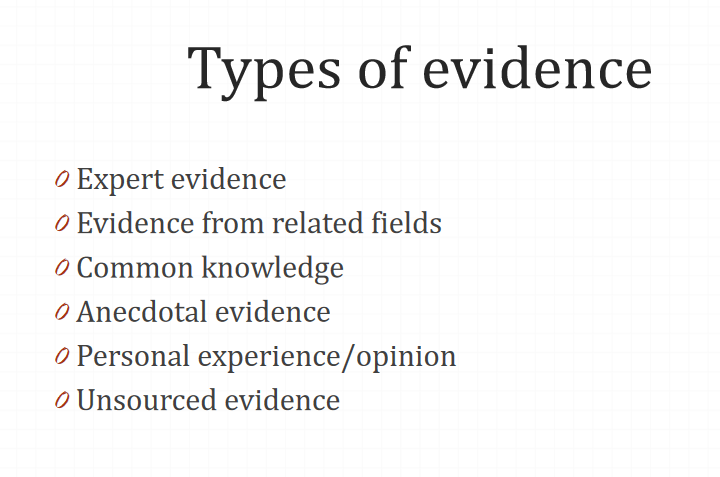
Among the forms of evidence you might draw from are:
- graphs, charts,tables, figures
- statistics
- experiments or studies done by peer-reviewed sources
- surveys conducted by reputable sources
- interviews
- quotes or paraphrases form primary sources
- quotes or paraphrases from secondary source
Pa ra ph rase 转述
To be considered effective, your supporting evidence should have a definite relationship to the claim you want to prove (relevant), be enough to make the argument convincing(sufficient), originate from credible and authoritative sources (reliable), and cite the latest and most updated information(current).
要被认为是有效的,你的支持证据应该与你想证明的主张有明确的关系(相关的),足以使论点令人信服(充分的),源自可信和权威的来源(可靠的),并引用最新和最新的信息(当前的)。
How to incorporate evidence?
转述:用自己的话报道作者的观点
引用:从原文中引用确切的话,并用引号标明
摘要:浓缩较长的文章的内容,甚至是几个不同的来源得出相同的结论
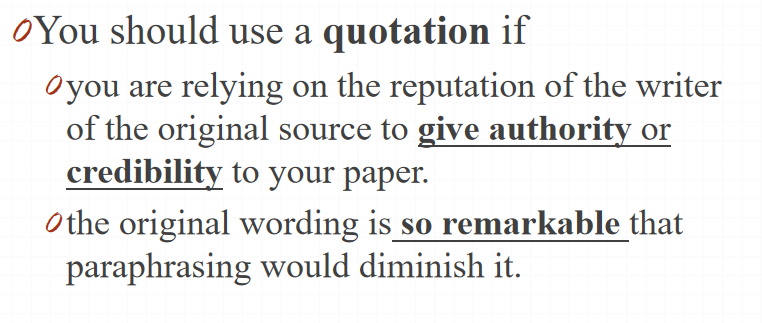
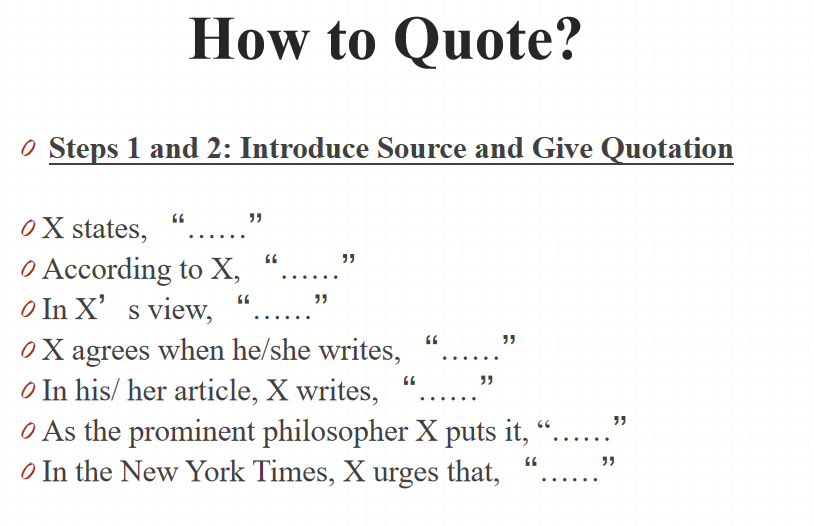
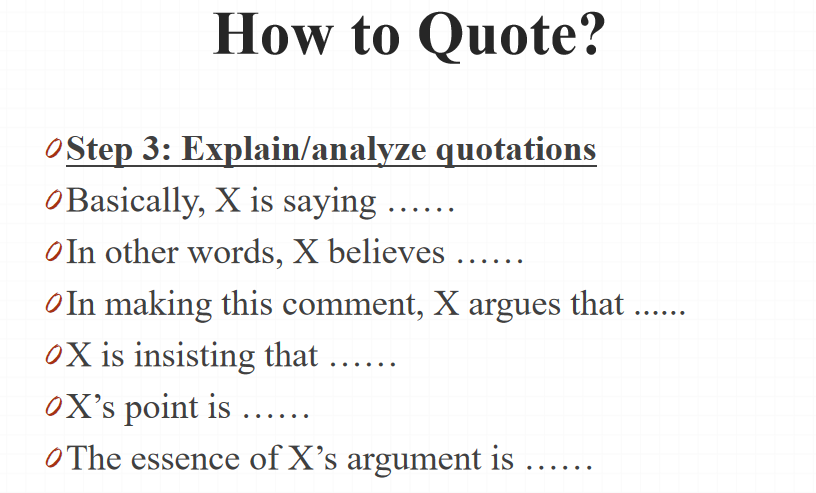

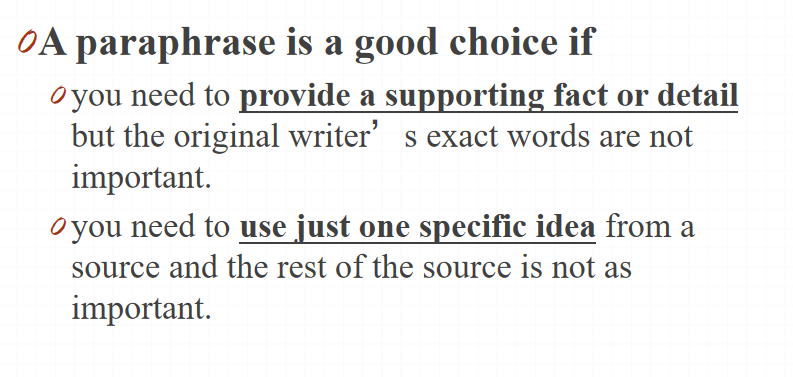
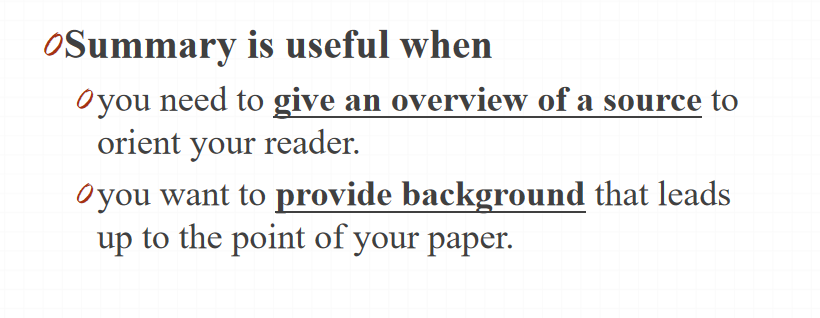
简单来说,quotation必须不修改并且加引号,summary必须有两个以上,剩下的就是paraphrase了
Unit 5 Computer Science
5.1 Academic Reading
Can Computers Be Conscious?
Paragraph 1.
Computers have seemed “mind-like” to people since they were invented in 1950s, In the early days they were widely called “electronic brains” for their ability to process information. But the similarity between computers and brains isn’t just superficial: At their most fundamental levels, computers and brains process data in a similar binary fashion. Whereas computers use zeros and ones to store and manipulate data, the neurons in our brains transmit information in binary, on/off spikes known as action potentials. This basic similarity is what underlies the burgeoning field of computational neuroscience, which hopes to understand how neuronal networks give rise to processes like memory and facial recognition so that they might be replicated in intelligent machines.
1 | '自从计算机在20世纪50年代被发明以来,它对人们来说就像“大脑”一样。在早期,由于它们处理信息的能力,它们被广泛称为“电子大脑”。但计算机和大脑之间的相似之处不仅仅是表面的:在最基本的层面上,计算机和大脑以类似的二进制方式处理数据。计算机使用0和1来存储和操作数据,而我们大脑中的神经元则以二进制的方式传输信息,开关峰值被称为动作电位。这种基本的相似性是计算神经科学这一新兴领域的基础,该领域希望了解神经元网络如何产生记忆和面部识别等过程,以便在智能机器中复制它们。' |
Paragraph 2.
But artificial intelligence has progressed slower than many had initially hoped. Yes, AI may have solved the game of checkers, but this is a far cry from being able to simulate consciousness. The central problem remains: We have no real understanding of how the brain gives rise to the mind, of how neurons and action potentials create consciousness.
1 | ''' |
Paragraph 3.
Instead of trying to build thinking machines from the ground up, several major projects have recently turned to a new approach: replicating virtual brains through reverse-engineering. By studying the neural networks in the brain, scientists have constructed computer-based models that mirror the brain’s complex biological networks. In turn, they can then run experiments on these brain-like computers in odrder to learn about how the brain thinks.
1 | ''' |
Paragraph 4.
Henry Markram is the South African neuroscientist who heads the Blue Brain Project at the Ecole Polytechnique Federale de Lausanne in Switzerland. For 15 years, Markram and his team collected data from the neocortexes of rats’ brains with the hopes of integrating it into a 3D model. If they could accurately recreate the behaviours and structures of a biological brain, their computer simulation should shed light on both normal cognition and disorders like depression and schizophrenia. In its trial stages the project successfully recreated a single neocortical column of a two-week-old rat, which contains about 10,000 neurons. Of course, this sample is infinitesimally small compared to the 100 billion neurons in a human brain. But this project is all a matter of scaling. “Technologically, in terms of computers and techniques to acquire data, it will be possible to build a model of the human brain within 10 years,” Markram told Discover magazine last year.
1 | ''' |
Paragraph 5.
But will this full-scale model teach us how to re-create consciousness, or perhaps even become conscious itself? “It’s really difficult tot say how much detail is needed for consciousness to emerge,” said Markram. “I do believe that consciousness is an emergent phenomenon. It’s like a shift from a liquid to a gas … It’s like a machine that has to run fast enough and suddenly it’s flying.” In other words, they can’t know for sure until the model is finished.
1 | ''' |
Paragraph 6.
Even if the model can learn and reason, that doesn’t guarantee that it will be a truly intelligent being. Many people studying AI have equated problem-solving with thinking, but thinking is different from reasoning, says Yale computer scientist David Gelernter. To demonstrate this, he points to daydreaming and free association. “Free association is a kind of thinking also. My mind doesn’t shut off, but I’m certainly not solving problems; I’m wandering around.”
1 | ''' |
Paragraph 7.
“The field of Artificial Intelligence had studied only the very top end of the spectrum and still tends to study only the very top end,” says Gelernter. “It tends to say, what is thinking? It’s his highly focused, wide awake, alert, problem-solving state of mind. But not only is that not the whole story, but the problem- the biggest unsolved problem that has tended to haunt philosophy of mind, cognitive philosophy and AI - is creativity.”
1 | ''' |
Paragraph 8.
The general consensus is that creativity is the ability to invent new analogies, to connect two things that are not obviously related. And this invention of analogy relies not on analytic problem-solving thought but on letting your mind drift from one thought to another in a sort of free-associative state, says Gelernter. “Creativity doesn’t operate when your focus is high,” Gelernter writes in an essay for Edge, “Only when your thoughts have started to drift is creativity possible. We find creative solutions to a problem when it lingers at the back of our minds, not when it monopolises attention by standing at the front.”
1 | ''' |
Paragraph 9.
So how can computers create new analogies? The answer probably has something do with emotion, says Gelernter. “Emotion is what allows us to take two thoughts or ideas that seem very different and connect them together, because emotion is a tremendously subtle kind of code or tag that can be attatched to a very complicated scene.” We tend to think of emotions is discrete terms, like happy, sad , and angry, but they’re really much more subtle than that. “If I say,'What is your emotion on the first really warm day in April or March when you go out and you don’t need a coat and you can smell the flowers blooming and there may be remnants of snow but you know it’s not going to snow anymore and there’s a certain springiness in the air, what do you feel?” Gelernter asks. “It’s not that you feel happy exactly. There are a million kinds of happiness. It;s a particular shade of emotion.” Though there may not be an exact word to describe this nuanced emotion, the mind can recognise it and can connect two very different scenes that may have inspired the same emotion.
1 | ''' |
Paragraph 10.
The other difficulty with emotion - and the reason why computers won’t ever be able to experience emotions the way humans do - is that they are produced by an interaction between the brain and the body working together. “When you feel happy, your body feels a certain way, your mind notices, and the resonance between body and mind produces an emotion,” Gelernter explains. Until computers can simulate this experience, they will never be truly intelligent.
1 | ''' |
5.2 Academic Reading Skills
Evaluating Argument


How to support a claim with evidence?
1️⃣ First, presenting and explaining statistics. Statistics will be used to convey information in a numerical form (referred to as data). Statistics are convincing when they are used in combination with an explanation of why the numbers are significant.
1 | ''' |
2️⃣ Second, providing appropriate examples. Examples can support the writer’s contention that a general statement is true. Examples can provide specifics and details in support a claim, as well as vivid descriptions which will capture and retain reader’s attention.
1 | ''' |
3️⃣ The third accepted way is quoting expert opinions are usually based on factual evidence to interpret other facts.
1 | ''' |
New Words and Expressions
| Words | Means |
|---|---|
| binary | 二进制 |
| manipulate | 操作,使用,掌控 |
| simulate | 魔方,模拟 |
| burgeoning | 迅速增长的 |
| infinitesimal | 无限小的 |
| analogy | 类似出,相似处 |
| haunt | 长期困扰 |
| consensus | 共同意见,一致看法 |
| monopolise | 占用 |
| subtle | 微妙的,细微的 |
| discrete | 离散的,分开的 |
| remnant | 剩余部分 |
| nuanced | 有细微差别的 |
| resonance | 共鸣 |